
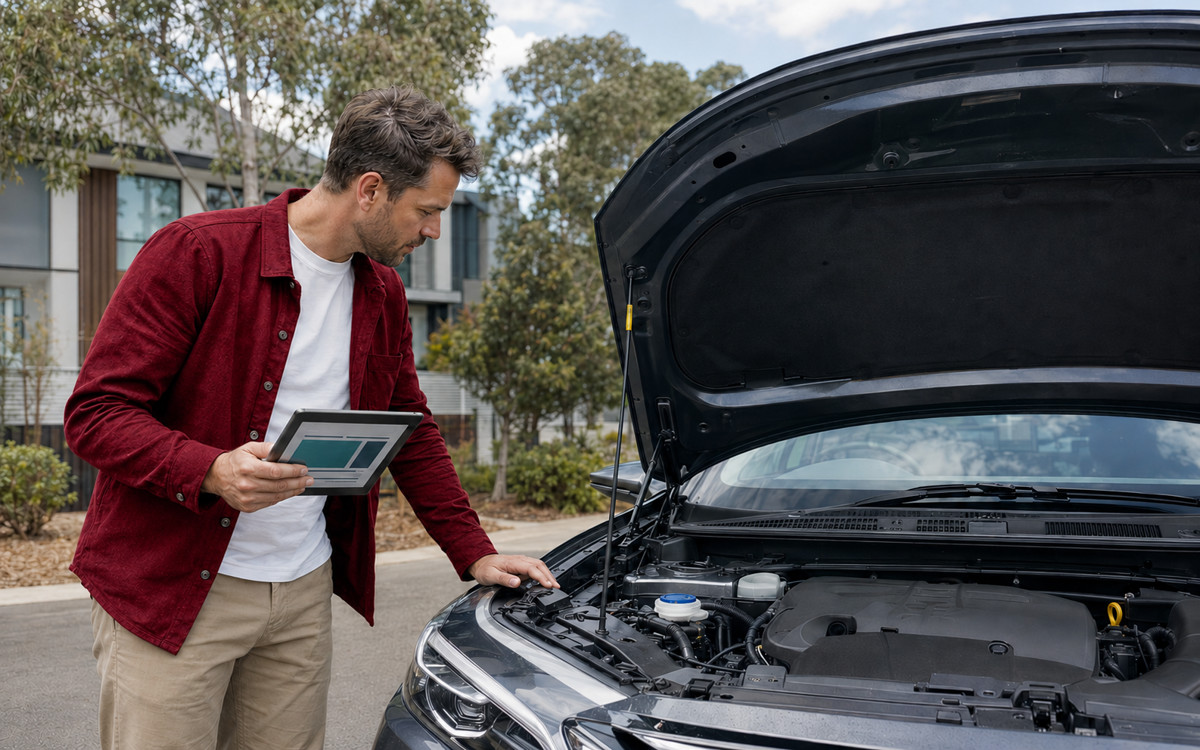
A PPSR check before buying a used car is a small but important step that can reveal whether a security interest is registered against the vehicle. It may also include stolen and written-off information connected to the vehicle identification number, or VIN. The official online self-service search currently costs $2, and the Australian Government recommends searching on the day of purchase or the day before. For a complete buying sequence, begin with the Used Car Buying Checklist for NSW and use this guide for the PPSR stage.
It is not a complete history or inspection. Complete separate registration, history and condition checks. This article is general information, not legal, financial or mechanical advice.
What Is a PPSR Check for a Used Car?
The Personal Property Securities Register is an Australian Government register used to record security interests in personal property. For a vehicle buyer, a registered security interest can indicate that another party, commonly a finance provider, has an enforceable interest connected to the car. If a private seller has not settled secured finance, the vehicle may be at risk of repossession even after a buyer has paid for it.
The official PPSR used-car guidance says a search may also return identity information and NEVDIS data about stolen or written-off status. It produces a certificate recording the result at that time. Auto Aura takes an education-first approach, but buyers should perform official checks themselves and seek advice when a result is unclear.
What Does a PPSR Search Tell You?
| A PPSR search can show | A PPSR search does not show |
|---|---|
| Registered security interests | The amount of finance owing |
| VIN or chassis-related identity details | The current owner or full ownership history |
| Stolen status when available | Odometer readings |
| Written-off status when available | Outstanding fines |
| A dated search certificate | The vehicle’s mechanical condition |
A clear result does not confirm the seller’s identity, prove the odometer is accurate, establish roadworthiness or replace an independent inspection.
Why Should You Complete a PPSR Check Before Buying a Used Car?
The main reason is to reduce the risk of buying a privately sold vehicle subject to a security interest. The PPSR buyer-protection guidance says a buyer will generally take a vehicle free of a claimed interest when the search uses the correct serial number, occurs on the sale day or day before, and is clear. Exceptions apply, so obtain legal advice for a dispute.
Timing and accuracy matter. A certificate for the wrong VIN, or one obtained weeks before payment, may not provide the expected evidence. Auto Aura’s NSW automotive information therefore emphasises layered verification rather than reliance on one report.
What Do You Need for a $2 PPSR Search?
For the official online self-service search, you need a credit or debit card and the vehicle’s VIN or chassis number. You cannot perform the official motor-vehicle search using only the number plate or engine number. Most vehicles built after 1989 have a 17-character VIN, while older vehicles may use a chassis number.
Find the VIN under the bonnet, in the engine bay, at the bottom of the windscreen, inside the driver’s-side door closure area or on registration documents. Do not copy it from the advertisement alone. Compare several locations and investigate anything obscured, altered or inconsistent.
How Do You Complete a PPSR Check Before Buying a Used Car?
Use the official Australian Government PPSR service when you want the official $2 certificate. Entering and reviewing the details accurately matters more than finishing quickly.
Step 1 — Confirm the VIN for a PPSR Check Before Buying a Used Car
Compare the identifier on the vehicle with the registration papers, service records and seller-provided information. For most post-1989 cars, expect a 17-character VIN. Verify every character; one error can produce an irrelevant or empty result. Pause if identifiers differ, even if the seller calls it a typing mistake. An independent inspector can examine possible alteration.
Step 2 — Open the Official PPSR Vehicle Search
Visit the Australian Government PPSR car-check page and follow the official transaction link. You do not need an account for the standard vehicle search. The online fee was $2 when researched on 24 August 2026, but confirm the current charge and requirements. Search fees are non-refundable.
Step 3 — Enter the Identifier and Review the Vehicle Details
Enter the VIN or chassis number exactly and recheck it before payment. Compare the returned make, model, colour and other identity information with the car. A clear security-interest field does not cancel an identity mismatch. If anything conflicts, stop and investigate through the appropriate PPSR, road authority, police or professional channel.
Step 4 — Save and Read the PPSR Search Certificate
Download the result and certificate and retain the email copy. Record the search time, identifier, seller details, advertisement and relevant written representations. Keep the complete certificate rather than relying on a screenshot.
Records to Save After the PPSR Check Before Buying a Used Car
Keep the certificate, receipt, advertisement, correspondence, seller documents and VIN photographs together. A seller’s older certificate is not current: retrieving an earlier result does not update it. Conduct your own new search close to payment.
When Should You Run the Search?
Run an initial search when the vehicle becomes a serious candidate, then run a fresh search on the day you buy it. Official PPSR first-car guidance recommends searching when you identify the vehicle and again on the purchase day. The second search provides the most current result close to the time money and possession change hands.
If the purchase is delayed, search again. A registration can change after the first certificate.
How Should You Read the PPSR Certificate?
Start with the search number, date, time and VIN. Confirm that the identifier exactly matches the vehicle. Next, look for any security-interest registration and review the secured-party information supplied. Then compare the identity details and check the stolen and written-off sections. Do not focus only on whether the certificate appears to say “clear.”
What If a Security Interest Appears?
Do not pay the seller or assume that their verbal promise to settle the loan is enough. Ask for a clear written explanation and evidence from the relevant secured party. The PPSR certificate does not state the amount of finance owing, and Auto Aura cannot determine whether a registration is valid or should be removed.
If unresolved, contact the secured party using independently verified details, seek legal advice or walk away. Do not improvise a settlement arrangement without professional guidance.
What If Written-Off or Stolen Information Appears?
Pause immediately and investigate through the relevant authority. Stolen and written-off data supplied with a PPSR search comes from NEVDIS through state and territory road agencies and police. The PPSR warns that this information may not always be available or current, and the PPSR itself cannot correct the source data.
A blank section is not a complete history guarantee, while a recorded status should never be dismissed on the seller’s explanation alone.
Which NSW Checks Should You Complete as Well?
A PPSR search does not replace NSW registration or vehicle-history checks. Use the free Service NSW registration check to review registration status and expiry, restrictions or concessions, CTP information and up to three recent annual odometer readings when available. That check uses the NSW number plate and applies to vehicles previously or currently registered in NSW.
The paid NSW vehicle history report can include written-off and stolen records, operator history, past use and available odometer readings. Mechanical inspection, service records, test driving and seller verification remain separate. This reflects Auto Aura’s focus on clearer automotive education without suggesting that one database approves a vehicle.
What Common PPSR Mistakes Should Buyers Avoid?
- Searching by a VIN copied only from the advertisement
- Entering one character incorrectly
- Searching weeks before payment and not searching again
- Accepting a seller’s old certificate instead of obtaining a fresh one
- Assuming a clear result proves ownership, condition or odometer accuracy
- Ignoring a make, model, colour or VIN discrepancy
- Treating unavailable NEVDIS data as proof that no stolen or written-off record exists
- Paying while a security interest or identity concern remains unresolved
- Forgetting to save the complete certificate and purchase records
If information does not align, slow down. A legitimate purchase should withstand reasonable verification.
A Practical Pre-Payment Sequence
Use the PPSR search as one stage in a wider decision process:
- Verify the seller’s identity and authority to sell.
- Inspect the VIN and compare it with the documents.
- Run an initial PPSR search for a serious option.
- Complete NSW registration and history checks.
- Arrange an independent mechanical inspection where appropriate.
- Resolve every discrepancy in writing.
- Search the PPSR again on the purchase day.
- Save the certificate, advertisement, receipt and correspondence.
Final Thoughts
A PPSR check before buying a used car is inexpensive and especially important in a private sale, but it depends on the correct VIN, timing and interpretation. It can identify registered security interests and may show stolen or written-off information, but it cannot confirm ownership, odometer accuracy or mechanical condition.
Auto Aura is preparing its planned online-first services and does not conduct regulated vehicle transactions. Learn about the current direction on the Auto Aura website or contact Auto Aura with a general, partnership, licensing or future-service enquiry. An enquiry does not constitute a vehicle transaction.
Frequently Asked Questions
How much does an official PPSR used-car search cost?
The official online self-service search cost $2 when researched on 24 August 2026. Charges can change, so confirm the current amount on the PPSR page. Check the VIN carefully because search fees are non-refundable.
Can I do a PPSR search using a registration plate?
No. The official search requires the VIN or chassis number; a plate or engine number cannot replace it. The separate Service NSW registration check accepts a NSW plate. Comparing both results helps confirm the car, documents and records align.
Does a clear PPSR certificate mean the car has no finance owing?
A clear search means no security interest was registered against that identifier at that time. It does not state the finance amount or guarantee every possible interest was captured. Protection depends on the input, timing and circumstances; seek legal advice if disputed.
Does a PPSR search show the vehicle’s owner?
No. It does not provide the current owner or ownership history. Independently verify the seller’s identity, authority and documents. A registered operator should not automatically be treated as conclusive legal proof of ownership.
Does a PPSR check include odometer readings?
No. For a NSW-registered vehicle, the free Service NSW check may display three recent annual readings when available. Compare them with the dashboard, service book, invoices, inspection and overall wear.
Should I search the PPSR if I am buying from a dealer?
The PPSR says buyers from a licensed motor vehicle dealer are generally protected, although exceptions apply. A search can still provide useful identity and record information. Verify the licence and seek advice if anything appears inconsistent.
What should I do if the seller gives me a PPSR certificate?
Review it, but conduct your own fresh search using the VIN verified on the car. An older certificate records only its original search time. Searching on the purchase day gives you a current certificate for your records.
